

Contents
Why This Question Matters Now
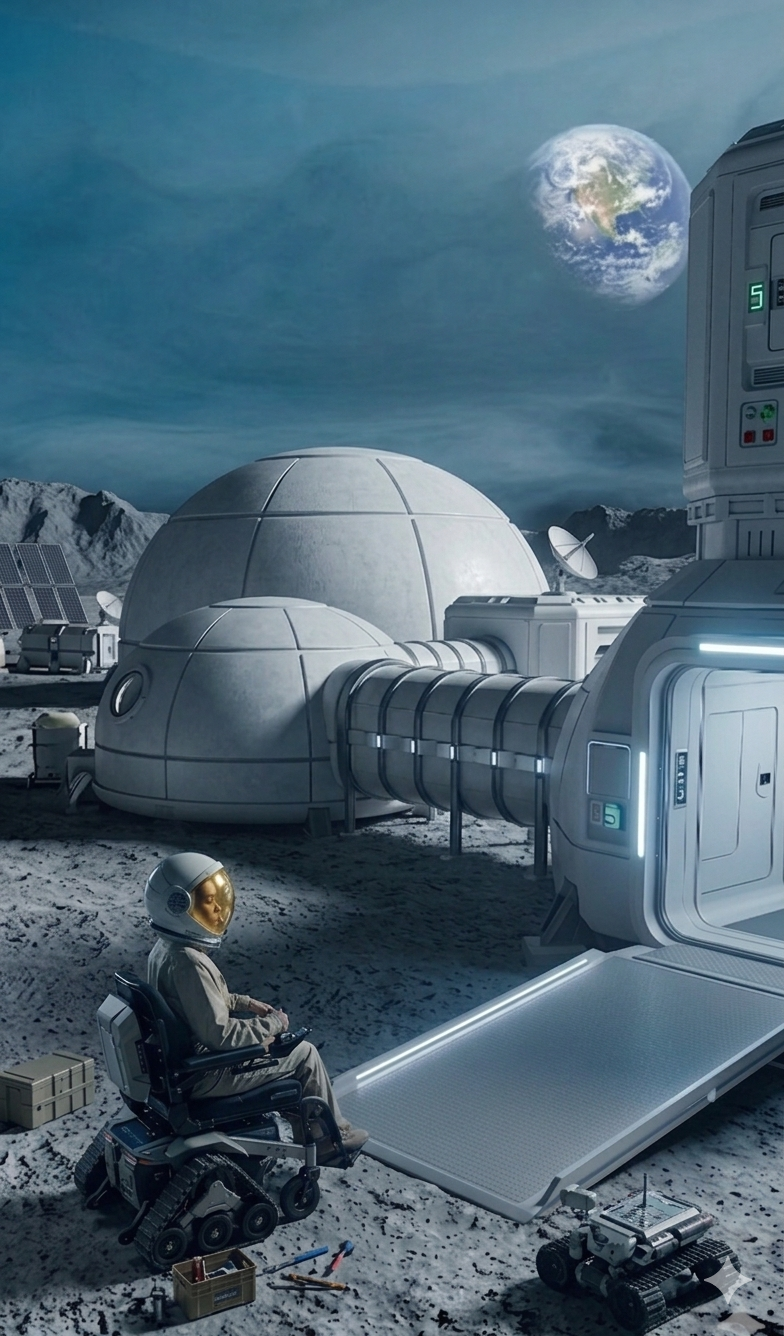
Humanity is returning to the moon. With programmes like NASA's Artemis and ESA's Lunar Gateway moving from concept to hardware, the question of who gets to go to space is becoming urgent — not philosophical.
The astronaut profession has diversified enormously over the past three decades. New nationalities, professions, and an increasing number of women have all gained access to space. In 2021, ESA launched its Parastronaut Feasibility Project and selected John McFall — the first European astronaut candidate with a physical disability (lower limb deficiency). Private spaceflight is growing sharply. The number of crewed launches per year is at a historic high.
Yet the built environment of space — the modules, suits, controls, and habitats — was designed almost entirely around a narrow physical standard. This is not just a fairness problem. Astronaut Leland Melvin partially lost his hearing during training. Chris Hadfield temporarily lost sight in one eye during an EVA. Statistical modelling of long-duration missions suggests roughly one mission-impacting medical event per six-month mission with a crew of seven. On a lunar base, the option to return to Earth may not exist.
Designing for physical diversity is not only an inclusion imperative. It is a mission safety requirement.
This study was conducted jointly by BIRNE7 e.V. (Erlangen, Germany) and the Advanced Concepts Team at ESA's European Space Research and Technology Centre (ESTEC) in Noordwijk, The Netherlands. The full research team: Antonia Sattler and Pablo Gómez (ESA/ACT) and Sebastian Schroth, Christian Schulz, and Jonas Jung (BIRNE7).
How the Study Was Conducted
The study used the ESA-SOM-MIT Proposed Habitat Design as its reference — a four-level cylindrical lunar habitat concept developed together with ESA and reviewed by ESTEC's Concurrent Design Facility. It is among the most detailed and recent lunar habitat concepts available, meeting four out of five primary engineering objectives.
Seven participants were recruited by BIRNE7 from Germany — an age range from mid-twenties to mid-sixties — each selected for both their lived experience with a physical disability and their professional expertise in accessibility. The group represented a wide range of conditions: paraplegia, muscular dystrophy, cerebral palsy, and blindness. Their professional backgrounds spanned barrier-free architectural design, disability rights, and off-grid independent living.
Each 90-minute interview was structured in three parts: a general discussion of the participant's daily experience and assistive technology needs; a structured walkthrough of the lunar habitat concept (either shown visually or described in detail for participants with visual impairments); and an open discussion for anything the structured format did not capture.
"Participants shared their experiences about so-called top-down solutions — designed for users with disabilities, but not with them. Many outcomes ended up neglecting aspects that only first-hand experience could have yielded."
— From the study findings, Section 4.1
What Current Designs Get Wrong
The participants identified ten specific elements in the habitat design that would be inaccessible — and for each, they proposed concrete alternatives. The analysis was structured around six functional categories: mobility, body movement, gripping, seeing, hearing, and speaking.
Problem: Inaccessible for wheelchair users and those with visual impairments. Alternative: Lift, lifting basket, or ramp.
Problem: Fixed standing position; inaccessible controls. Alternative: Lower placement, voice control.
Problem: Requires crouching and stepping. Alternative: Square shape, ground-level entry, no step.
Problem: Manual floor flap requires precise body movement. Alternative: Electric or voice control.
Problem: Visual-only orientation; inaccessible for users with visual impairment. Alternative: Tactile guidance strips with different patterns for each room.
Problem: Requires bilateral leg function. Alternative: Diverse equipment — hand bike, barbells, pull-up bar.
Problem: Hazard for mobility and body movement. Alternative: Closed surface or continuous railing.
Problem: Manual fold/unfold requires gripping and body movement. Alternative: Motorised table with voice control.
Problem: Manual adjustment inaccessible for limited mobility. Alternative: Electric or voice control.
Problem: Climbing required; no transfer support. Alternative: Adjustable bed height matching wheelchair level, transfer board, open space below.
Critically, for every problem identified, participants also described an existing solution — drawing on decades of accessibility innovation on Earth. The barriers are real. But so are the answers.
Low Gravity as an Unexpected Equaliser
One of the most striking findings from the interviews was unanimous: not a single participant identified the Moon's one-sixth gravity as a disadvantage for them.
Most stated the opposite. Many of the barriers they face on Earth are connected directly to gravity — the effort required to lift the body, transfer from a wheelchair, transport heavy objects, or maintain balance. In a low-gravity environment, several of these barriers reduce or disappear entirely. Designs that are not viable on Earth — steady ramps, manually powered pulley lifts — become physically feasible on the lunar surface.
This opens an important design implication: the Moon is not simply a harder version of Earth. For some users and some needs, it may actually be easier. That potential deserves its own research focus.
Five Principles for Inclusive Space Design
The study's discussion section synthesised the interview findings into five core principles for anyone designing human environments beyond Earth — or, for that matter, on it.
-
Include people with disabilities in the design process, not just in the output
Top-down solutions — designed for disabled users without them — consistently miss things that only first-hand experience can surface. Diverse design teams produce better outcomes.
-
Increase the detail resolution of habitat concepts
Current concepts lack sufficient interior detail to evaluate real usability. Sanitary facilities, work surfaces, and equipment need physical representations for meaningful accessibility assessment.
-
Research low gravity's specific effects on physical disability
The Moon is not Earth at reduced scale. Reduced gravity creates new design possibilities and may fundamentally change the capability profile of astronauts with various physical conditions.
-
Make multimodal and modular design the default, not the exception
No single set of designs serves all users. Systems must be adaptable: voice control as a fallback, modular attachments, screens with adjustable contrast, tactile alternatives to visual-only interfaces.
-
Train all astronauts to use accessible tools before injury occurs
On long-duration missions, any astronaut may need to rely on accessible design. Pre-mission training with assistive tools removes the fear and unfamiliarity that compounds the impact of an injury.
What This Means Beyond Space
The study is titled "Accessibility on a Lunar Base." But its implications extend well beyond space architecture.
The methodology — structured co-evaluation of a design concept with expert users who have lived experience of physical disability — is directly applicable to any design process. The finding that accessible design usually produces multimodal and redundant systems echoes what accessibility advocates have argued for decades: designing for the margins makes things better for everyone.
For BIRNE7, the study represents something specific: proof that lived experience, when structured and connected to technical partners, produces findings that conventional design review cannot. The seven participants in this study contributed knowledge that no simulation or standard assessment could have generated.
That is the model. Start from the barrier. Bring in the people who live it. Connect their expertise to the people building the systems. The moon is far away. But the principle applies here, today, in every domain where environments are built for a narrower range of people than those who will use them.
Read the Full Paper
The complete feasibility study — including the full interview questionnaire, technical constraint tables, and all ten accessibility recommendations with alternatives — is published and freely available.